





















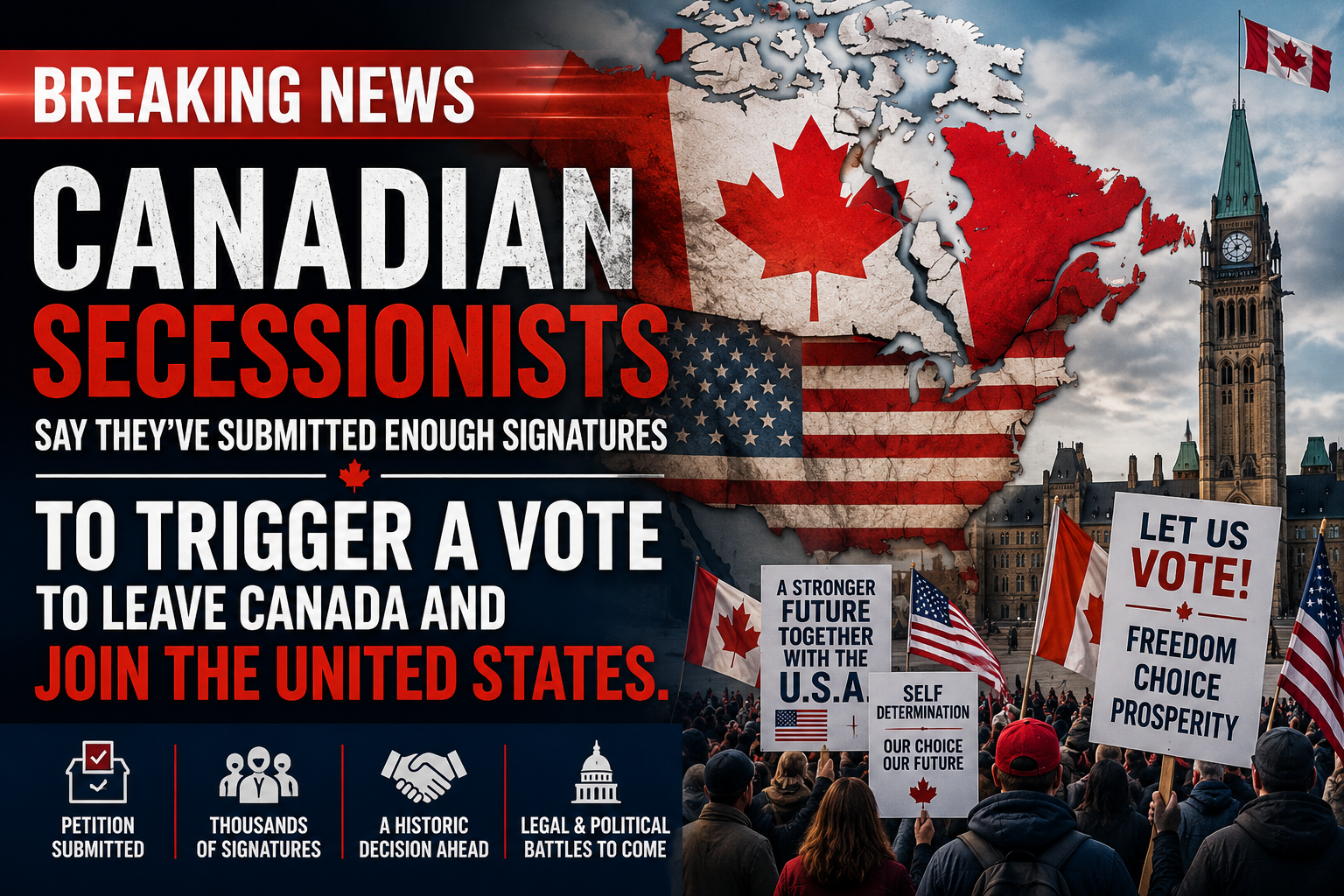
A controversial political movement is gaining traction as Canadian secessionists they have gathered enough signatures to trigger a historic vote on leaving Canada and pursuing annexation by the United States. The development has sparked intense debate across North America, raising questions about sovereignty, identity, and geopolitical stability.
A Political Shockwave Across North America
A coalition of Canadian secessionist groups has announced that it has officially submitted what it claims are sufficient signatures to force a regional vote on breaking away from Canada and seeking entry into the United States.
If verified, the move could set the stage for one of the most unprecedented political events in modern North American history.
Organizers behind the initiative argue that economic alignment, political dissatisfaction, and cultural ties with the United States have driven growing support for the proposal. Critics, however, have dismissed the effort as unrealistic, legally questionable, and deeply divisive.

Legal and Constitutional Hurdles
Despite the bold claims, constitutional experts warn that the road ahead is anything but straightforward.
Canada’s legal framework sets a high bar for secession, requiring:
- Clear majority support in a formal referendum
- Federal negotiations
- Potential constitutional amendments
Even if a region votes in favor of leaving, there is no automatic pathway to join the United States. Any such move would also require approval from:
- The U.S. Congress
- The President
- Possibly individual states
In short, the process could take years—if it succeeds at all.
Political Reactions Mount
Government officials in Ottawa have yet to formally confirm the validity of the petition, but early reactions suggest strong resistance at the federal level.
Meanwhile, political figures in the United States have offered mixed responses, ranging from cautious curiosity to outright rejection of the idea.
The situation has also ignited fierce debate among citizens:
- Supporters call it a “path to economic strength and freedom”
- Opponents warn of “national fragmentation and identity loss”
Economic and Strategic Implications
If such a proposal were ever realized, the consequences would be profound:
- Trade and currency shifts
- Border and immigration restructuring
- Military and defense realignment
- Energy and resource control disputes
Markets could react sharply to uncertainty, while global allies would closely monitor the stability of the region.

A Movement or a Moment?
While secession movements are not new in Canada, this is one of the few instances where annexation by another country—particularly the United States—has been explicitly proposed.
Whether this is a serious turning point or a short-lived political surge remains to be seen. Much will depend on:
- Verification of signatures
- Government response
- Public support in a potential referendum
Final Word
The idea of redrawing North America’s borders may seem unlikely—but it is no longer unthinkable. As this story develops, it could test the limits of democracy, national identity, and international law in ways rarely seen in modern history.